
Office Address
Ist Floor, 38 N, Shree Balaji Tower Hisar
Phone Number
+91 98965-80000
Email Address


Ist Floor, 38 N, Shree Balaji Tower Hisar
+91 98965-80000


 by Anand Prakash Gupta
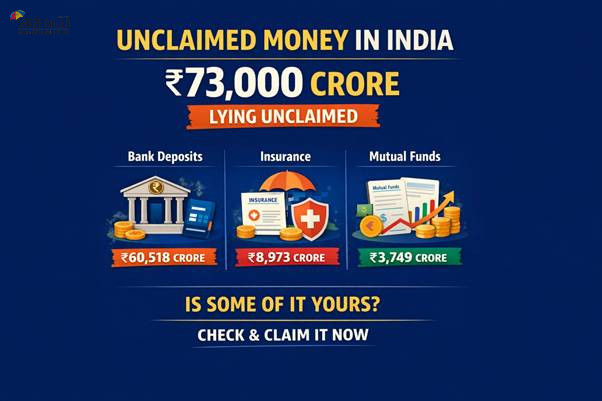
In a country where every rupee counts, it is surprising to learn that over ₹73,000 crore is lying unclaimed across bank deposits, insurance policies, and mutual funds in India. This is not forgotten government money. It belongs to individuals and families who either lost track of their investments or were never aware of them in the first place.
If you have ever changed banks, invested years ago, or had an insurance policy you stopped monitoring, there is a real possibility that some of this unclaimed money could be yours.
This blog will help you understand what unclaimed money is, why it happens, and most importantly, how to check and claim your unclaimed funds in India.
Table of contents [Show]
Unclaimed money refers to financial assets that have not been accessed or claimed by their rightful owners for a long period of time.
This includes:
When such funds remain untouched for years, they are transferred to regulatory authorities. For example, unclaimed bank deposits are moved to the RBI’s Depositor Education and Awareness Fund. However, the ownership of the money does not change. You can still claim it anytime.
The reasons are more common than you might think.
Many people open multiple bank accounts and forget older ones. Fixed deposits mature but are not tracked. Insurance policies are purchased but details are misplaced. In some cases, family members are unaware of investments made by loved ones.
Here are some key reasons:
In today’s fast-paced life, it is easy for financial assets to slip through the cracks.
Recent reports highlight that:
These numbers are growing every year, which makes financial awareness more important than ever.
If you want to check unclaimed bank deposits in India, the RBI has made the process easier through a centralised platform.
The UDGAM portal allows you to search for unclaimed deposits across multiple banks.
Steps to check:
This is one of the fastest ways to track forgotten bank accounts and fixed deposits.
Unclaimed insurance money often includes maturity benefits, survival benefits, or death claims that were never processed.
To check:
If you find an unclaimed insurance policy, you can file a claim with the insurer along with required documents.
Mutual fund investments are often forgotten, especially those made years ago.
To track them:
You may discover investments that have grown significantly over time.
Once you identify unclaimed funds, the next step is to claim them.
The process usually involves:
In case of deceased account holders, legal heirs may need to submit additional documents such as a death certificate and succession proof.
Many people delay checking their financial records because they assume the amount might be small. However, even small investments can grow over time.
Here is why you should act immediately:
A simple check today can help you recover money that belongs to you.
Preventing unclaimed assets is just as important as finding them.
Follow these simple practices:
Financial awareness is not just about earning money. It is about managing and protecting it.
The rise in unclaimed funds highlights a larger issue in India which is lack of financial awareness and asset tracking.
Individuals often focus on earning and investing but overlook organisation and documentation. This leads to money being forgotten or left unclaimed.
At Shree Balaji Insurance Brokers, we believe that awareness is the first step towards financial security. Whether it is insurance planning, asset tracking, or risk management, staying informed ensures that your hard-earned money is always within your reach.
₹73,000 crore is not just a statistic. It represents millions of individuals who have lost track of their own money.
The good news is that this money is still accessible. With the right tools and a little effort, you can check and reclaim what is rightfully yours.
Take a few minutes today to review your financial history. Check your bank accounts, insurance policies, and mutual fund investments.
Because sometimes, the money you are looking for is already yours.