
Office Address
Ist Floor, 38 N, Shree Balaji Tower Hisar
Phone Number
+91 98965-80000
Email Address


Ist Floor, 38 N, Shree Balaji Tower Hisar
+91 98965-80000


 by Anand Prakash Gupta
International trade plays a vital role in today’s global economy. Businesses of all sizes are importing and exporting goods across borders, tapping into new markets and customers worldwide. However, global trade is not without challenges. One of the most common areas of confusion is understanding Incoterms and how they affect international shipping, costs, and responsibilities.
Incoterms, or International Commercial Terms, are standardised rules that clearly define the responsibilities of buyers and sellers in international trade transactions. When used correctly, Incoterms reduce misunderstandings, prevent disputes, and help businesses plan their logistics more efficiently. This guide explains Incoterms in simple language and shows how they impact global trade.
Table of contents [Show]
Incoterms are a set of globally accepted trade rules created by the International Chamber of Commerce. They are used in international sales contracts to define who is responsible for transportation, insurance, customs clearance, and risk during the movement of goods.
Each Incoterm specifies the point at which responsibility shifts from the seller to the buyer. This includes who pays for shipping, who handles export and import documentation, and who bears the risk if goods are damaged or lost during transit.
The most recent version, Incoterms 2020, is widely used in international trade and remains relevant for most global transactions today.
Understanding Incoterms is essential for anyone involved in cross-border trade. They help both parties avoid costly mistakes and ensure smooth coordination between sellers, buyers, freight forwarders, and customs authorities.
Incoterms provide clarity on cost distribution, reduce legal risks, and improve transparency in contracts. Without clearly defined Incoterms, businesses may face unexpected charges, shipment delays, or disagreements over responsibility if something goes wrong.
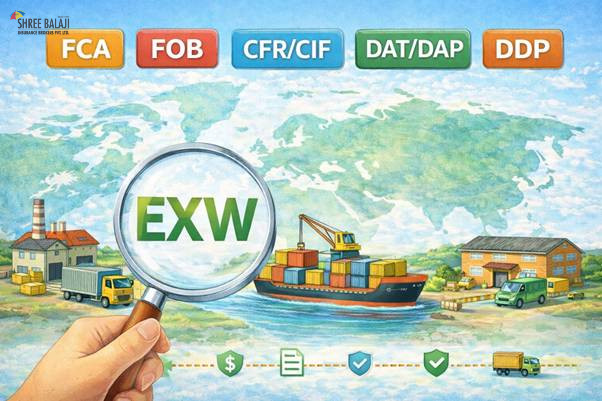
There are several Incoterms used in global trade, but some are more common than others. Below is a simplified explanation of the most widely used Incoterms in international shipping.
EXW, or Ex Works, places maximum responsibility on the buyer. The seller makes the goods available at their premises, such as a factory or warehouse. From that point onward, the buyer handles transportation, export customs, insurance, and all associated risks.
EXW is often used in domestic trade or when buyers have strong logistics capabilities. However, it can be challenging in international trade since buyers may struggle with export clearance in the seller’s country.
FCA, or Free Carrier, is one of the most flexible Incoterms. The seller delivers the goods to a carrier or location specified by the buyer. The seller is responsible for export customs clearance, while the buyer takes over responsibility once the goods are handed to the carrier.
FCA is commonly used in containerised shipping and offers a balanced division of responsibility between buyer and seller.
CFR, or Cost and Freight, is used exclusively for sea and inland waterway transport. The seller pays for transportation to the destination port, but the risk transfers to the buyer once the goods are loaded onto the vessel.
This Incoterm is popular for bulk and non-containerised cargo, where sellers have strong shipping arrangements.
CIF, or Cost, Insurance, and Freight, is similar to CFR but includes insurance. The seller pays for freight and minimum insurance coverage up to the destination port. However, the risk still transfers to the buyer once the goods are loaded on the vessel.
CIF is widely used in international trade as it provides buyers with basic insurance protection.
DAP, or Delivered at Place, means the seller delivers the goods to a specified destination, ready for unloading. The seller bears all risks and costs until delivery, except for import duties and taxes.
DAP is often preferred when sellers want more control over logistics and ensure smoother delivery for buyers.
DDP, or Delivered Duty Paid, places the maximum responsibility on the seller. The seller handles transportation, export and import customs clearance, duties, taxes, and delivery to the buyer’s location.
DDP offers the highest level of convenience for buyers but requires sellers to have strong knowledge of import regulations in the destination country.
Selecting the correct Incoterm depends on several factors, including logistics expertise, cost control, risk tolerance, and market practices. Businesses new to international trade often prefer Incoterms that limit their responsibilities, while experienced exporters may choose terms that provide greater control over shipping.
It is important to consider transportation mode, destination country regulations, and insurance requirements before finalising an Incoterm. Consulting with freight forwarders or trade experts can also help in making the right choice.
One of the most common mistakes is assuming Incoterms cover everything in a trade contract. Incoterms do not address payment terms, ownership of goods, or breach of contract issues. They strictly focus on delivery, risk, and cost responsibilities.
Another frequent error is using the wrong Incoterm for the mode of transport. For example, using sea freight terms for air shipments can lead to confusion and disputes.
Incoterms play a critical role in global supply chains by standardising trade practices across countries. They enable smoother coordination between manufacturers, logistics providers, customs authorities, and buyers.
By clearly defining responsibilities, Incoterms reduce delays, improve cost planning, and enhance trust between trading partners.
Incoterms are the foundation of successful international trade. They bring clarity, reduce risks, and help businesses manage logistics more effectively. Whether you are exporter shipping goods overseas or an importer receiving cargo from abroad, understanding Incoterms can make or break your trade operations.
By choosing the right Incoterm and using it correctly in your contracts, you can avoid unnecessary disputes, control costs, and build stronger global partnerships. In the world of international trade, clarity is power, and Incoterms provide exactly that.