
Office Address
Ist Floor, 38 N, Shree Balaji Tower Hisar
Phone Number
+91 98965-80000
Email Address


Ist Floor, 38 N, Shree Balaji Tower Hisar
+91 98965-80000


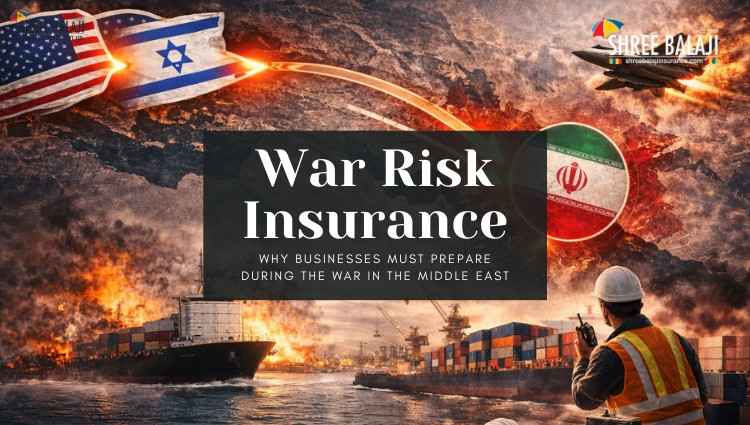
 by Anand Prakash Gupta
The world is once again witnessing rising geopolitical tensions as the war in the Middle East continues to escalate. The conflict involving Israel, the United States, and Iran has become more than a political issue. It is now directly impacting global trade, shipping routes, aviation networks, and supply chains.
For businesses that rely on international logistics, imports, exports, or global transportation, this situation raises an important question.
Are your business risks actually covered if war disrupts your operations?
Many organisations believe their standard insurance policies will protect them in such situations. Unfortunately, that assumption is often incorrect. Most traditional insurance policies exclude damages caused by war, terrorism, invasion, or hostile acts. This is exactly where War Risk Insurance becomes essential.
In times of global uncertainty, understanding the importance of war risk insurance coverage, marine war risk insurance, and aviation war risk insurance can protect businesses from massive financial losses.
Let us explore why this specialised protection is becoming increasingly important for businesses across the world.
Table of contents [Show]
War Risk Insurance is a specialised type of insurance designed to protect businesses against losses caused by war related events. These events may include war, invasion, civil unrest, terrorism, missile attacks, sabotage, and other hostile activities.
Unlike standard insurance policies, war risk insurance specifically covers damages that arise from geopolitical conflicts.
For businesses involved in international trade, shipping, aviation, logistics, and global supply chains, the risks associated with war can be extremely costly. A single disruption in a major trade route can delay shipments, damage cargo, or stop operations entirely.
War risk insurance helps companies mitigate these risks by offering financial protection when traditional insurance policies do not apply.
In today’s unpredictable global environment, war risk coverage is no longer an optional layer of protection. It is becoming a strategic part of business risk management.
The ongoing war in the Middle East involving Israel, the United States, and Iran has already begun affecting global economic stability.
One of the most critical areas impacted is the Strait of Hormuz, a key maritime chokepoint through which a significant portion of the world’s oil and cargo shipments pass every day.
Any disruption in this region can lead to several major consequences such as:
Shipping delays and route diversions
Increased freight and logistics costs
Cargo damage or loss
Aviation route disruptions
Global trade uncertainty
For businesses involved in international trade, these disruptions can quickly translate into operational and financial losses.
This is why companies are now reconsidering their insurance strategies and exploring war risk insurance for shipping and cargo to protect their assets.
One of the most surprising realities for many businesses is that war related damages are usually excluded from standard insurance policies.
Traditional insurance policies such as property insurance, marine insurance, and cargo insurance typically include a clause that excludes damages caused by war or hostile acts.
This means that if a shipment is destroyed due to a missile strike or if a vessel is seized during a conflict, the standard insurance policy may not provide any compensation.
This gap in coverage is exactly why war risk insurance policies exist.
War risk insurance acts as a specialised extension that fills this gap and provides protection where standard insurance stops.
Without this coverage, businesses could face severe financial losses during times of geopolitical conflict.
For businesses involved in maritime trade, marine war risk insurance plays a critical role.
Shipping companies, exporters, importers, and logistics providers rely heavily on safe maritime routes. However, during geopolitical conflicts, these routes can become high risk zones.
Marine war risk insurance protects vessels and cargo against risks such as:
War related attacks on ships
Missile strikes or sabotage
Seizure of vessels by hostile forces
Damage caused during military operations
Piracy and armed conflict at sea
Given that a large portion of global trade moves through maritime routes, marine war risk insurance ensures that businesses can continue operations with financial protection.
As conflicts intensify in regions like the Middle East, war risk premiums for shipping often increase due to the heightened threat level.
This highlights the importance of securing adequate protection before risks escalate further.
The aviation industry is another sector heavily impacted by geopolitical conflicts.
Airspace restrictions, missile threats, and military operations can force airlines to reroute flights or suspend operations in certain regions.
Aviation war risk insurance protects aircraft operators, airlines, and aviation companies against losses caused by war related incidents.
These risks may include:
Missile strikes targeting aircraft
Terrorist attacks
Hijacking or sabotage
Military conflicts affecting airspace
Damage to aircraft during conflict situations
Without aviation war risk insurance, airlines and aviation businesses may face enormous financial exposure during conflicts.
This coverage ensures that aviation operations remain protected even in highly volatile geopolitical environments.
War does not only affect nations. It affects global commerce.
When conflicts disrupt major trade routes or transportation networks, businesses across industries feel the impact.
War risk insurance for businesses provides protection against several types of disruptions, including:
Loss or damage to cargo during war related incidents
Vessel damage caused by military activity
Business interruptions due to conflict zones
Increased operational risks in high-risk regions
Companies involved in import export trade, manufacturing supply chains, and international logistics benefit significantly from this specialised protection.
By securing war risk insurance, businesses can continue operating even during uncertain geopolitical situations.
The global risk environment has changed dramatically in recent years.
Geopolitical tensions, trade conflicts, and regional wars are now influencing supply chains and business operations worldwide.
Companies can no longer assume that political conflicts will remain distant events. The ripple effects of war can quickly reach global markets, affecting logistics networks, shipping routes, and aviation corridors.
This is why many organisations are now reviewing their risk management strategies and investing in war risk insurance coverage.
For businesses that operate in international markets, this protection is becoming an essential safeguard against unpredictable global events.
Understanding war risk coverage can be complex. Policies vary depending on industry, location, and the specific risks involved.
This is where experienced insurance brokers play a critical role.
Insurance brokers help businesses:
Identify gaps in their existing insurance coverage
Evaluate geopolitical risk exposure
Structure customised war risk insurance policies
Ensure compliance with global insurance standards
Provide guidance during claims and risk assessments
By working with professional insurance brokers, companies can ensure that their risk protection strategies are aligned with the current global environment.
The war in the Middle East involving Israel, the United States, and Iran is a powerful reminder of how quickly global stability can change.
While businesses cannot control geopolitical conflicts, they can certainly prepare for their impact.
War risk insurance offers a critical layer of protection that standard policies often overlook. For industries dependent on global trade, shipping, aviation, and logistics, this coverage can be the difference between financial resilience and devastating loss.
In a world where geopolitical tensions can disrupt supply chains overnight, preparedness is not just a strategy. It is a necessity.
Because sometimes the most valuable insurance policy is the one you hope you never have to use.